


Peter Todd, who has been a contributor to Bitcoin Core for many years, has become the head maintainer of Slipstream, a service of MARA Foundation that redirects transactions to MARA Pool without going through Bitcoin’s public peer-to-peer network.
Todd’s work background makes him well-suited for the position. He has worked on transaction relay and fee policy for a very long time, while Slipstream is designed for transactions that may not move easily through standard mempools.
The developer behind RBF now runs a private channel
Todd has been researching the movement of Bitcoin transactions without confirmations for quite some time. He co-authored BIP 125, where he developed and standardized the concept known as opt-in replace-by-fee. After that, he created Libre Relay, which is a modified version of Bitcoin Core with relaxed relay rules.
Todd independently announced his involvement with Slipstream and instantly linked it to the wide-ranging issue of private mempools:
“Announcement: I’m now the lead maintainer of Slipstream @MARAFoundation_
I’ll actually be giving a short talk on private mempools at the upcoming TABConf – it’s really interesting how Slipstream was useful during the coldcard hack.” — Peter Todd, in a post on X
His Coldcard reference shows that private mempools are no longer just a technical debate. In some cases, keeping a transaction out of public view can have real consequences.
What the relay policy actually blocks
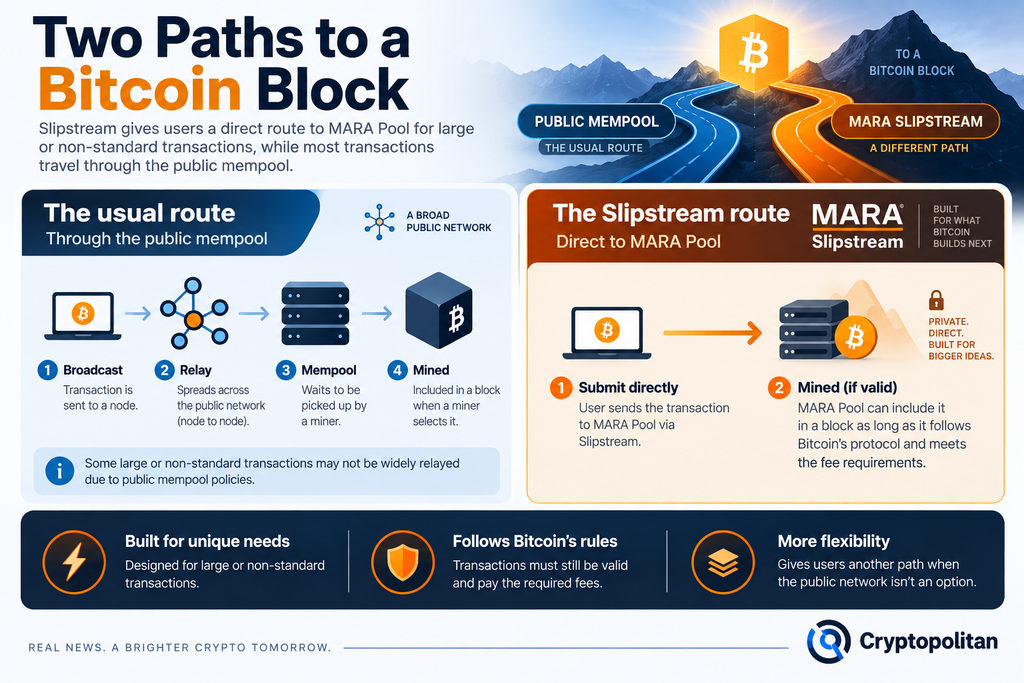
Bitcoin’s relay policy differs from its consensus mechanism. According to the Bitcoin Core documentation, relay policy is defined as a set of additional, locally configurable rules that nodes impose upon unconfirmed transactions before accepting them into their mempools. These rules do not apply anymore once a transaction is already in the block.
Slipstream allows users to bypass the normal functioning of a relay path. It was introduced by MARA in February 2024 for the processing of large or non-standard transactions. MARA Pool eliminates the need for a public relay method as users have the capability to conduct transactions directly through the Pool, which adheres to the principles of Bitcoin and its applicable fee requirements.
Coldcard recovery and quantum experiments
In a July 2026 advisory, Coldcard warned that any firmware from 2021 up to July 2026 may be prone to generating poor entropy. Users who have been impacted by this flaw were encouraged to regenerate their secrets and do whatever is necessary to move funds on-chain immediately.
One complication was that a recovery transaction exposing a multisig script could remain unconfirmed long enough for an attacker to see it and try to create a competing transaction with a higher fee. Todd pointed to Slipstream as a way to reduce that risk by keeping the transaction out of the public mempool until it was mined:
“because they promise to keep your transaction – and thus pubkeys – secret until they’re already in a block. Dramatically reducing the ability of the attacker to steal the funds.”— Peter Todd, quoted by Bitcoin Magazine
He added that the protection was most useful when addresses had not already been reused:
“If you’ve already reused addresses, this isn’t relevant, and you should just try to move your funds ASAP. But if you haven’t, MARA may be able to help.” — Peter Todd, quoted by Bitcoin Magazine
MARA Foundation later said that Slipstream facilitated the transfer of over 9000 BTC from susceptible multisignature wallets.
The service has also worked on experimental transactions. Previously, Cryptopolitan reported that StarkWare’s first quantum-safe Bitcoin transaction has reached mainnet via Slipstream, after failing to go through the standard mempool route.
Private channels, such as Slipstream, provide miners with an alternative solution for processing transactions that may be prohibited by public relay rules, whether it is during a moment of crisis as in the case of the Coldcard recovery or in experiments like StarkWare’s quantum-safe transaction. The downside, however, is that this type of operation takes place away from the public mempool. Todd’s involvement in Slipstream begs the question of how much Bitcoin routing will change due to miner channels.
The smartest crypto minds already read our newsletter. Want in? Join them.