



According to CoinMarketCap data, Celestia’s TIA was trading at approximately $0.48 on September 23, which is about 11% higher than the previous 24 hours. The increase was announced on the heels of Celestia’s release of an updated Sustainable Blob Economy governance package on September 22.
The proposal also poses a much broader question for the data-availability market: does Celestia have the capability of maintaining their blockspace affordability in a way that will bring rollups to their platform while converting such use into a steady source of revenue for the protocol?
What the proposal actually asks the community to approve
The forum package consists of six different proposals, all covered under an umbrella expenditure of $1.5 million, which includes funds for the feasibility phase at $225,000. These are ceilings of expenditure, and not an automatic allocation of funds. Additionally, each phase will need a separate approval.
Forum support establishes direction. It does not execute a community-pool transfer, approve unspecified software, or constitute adoption of a formal CIP.” — Celestia Sustainable Blob Economy Governance Package, Version 2.0, September 22, 2026
The plan progresses from $225,000 in the feasibility-and-design phase to $825,000 in the implementation-and-integration phase. Thereafter, the plan will implement a $450,000 independent review and pilot preparation phase.
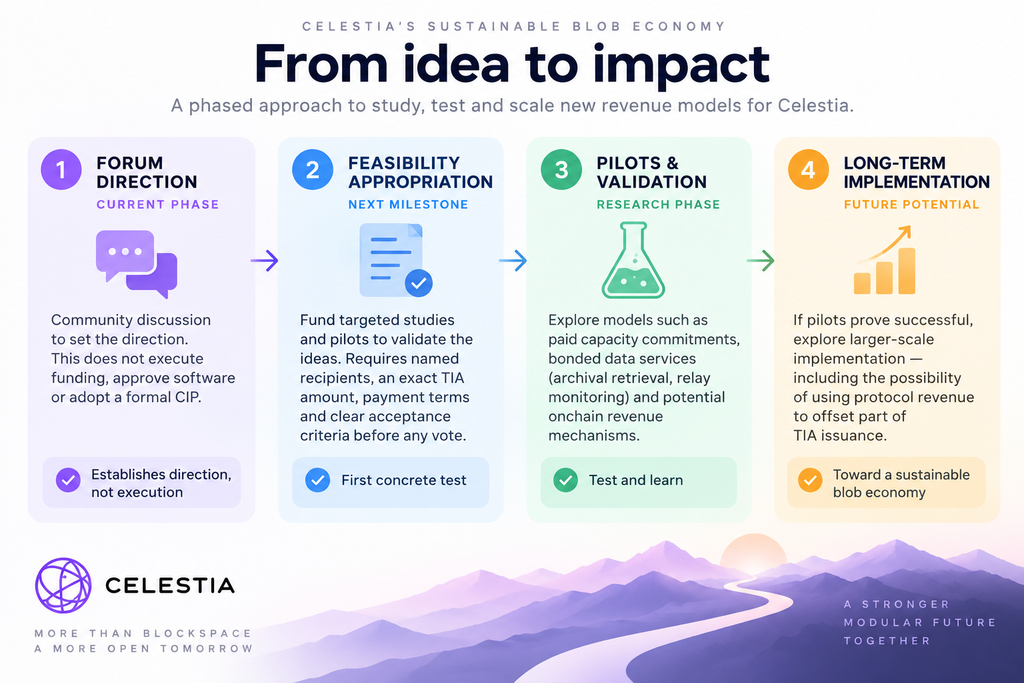
The central goal is searching for means of making Celestia able to generate more than merely the basic pricing for blobspace. The proposal addresses the idea of introducing paid capacity commitments, which will allow clients to receive priority service under certain conditions, as well as bonded services (including archival retrieval and relay monitoring). Another question that the proposal aims to address is whether at least some amount of money obtained from the protocol might be used to cover part of TIA issuance.
Nothing has been switched on yet
There hasn’t yet been any implementation of these proposals. None of the proposed issuance changes, new fee system changes, or mainnet service initiatives have received any approval.
The proposal defines what constitutes real revenue. Refundable customer funds and provider collateral are not included as revenue, and merely paying in TIA does not create sufficient and long-lasting demand for the token. The revenue need to be routed to the security of the budget via an enforceable mechanisms onchain for validators to benefit from it.
This distinction is important since Celestia has already reduced its token issuance. The documentation for its token supply states that following the adoption of upgrade v6, CIP-41, TIA inflation decreased to around 2.5% in November 2025. Furthermore, the inflation will continue to decrease by 6.7% every year until it reaches the 1.5% mark.
For now, the idea of replacing some TIA issuance with steady protocol revenue remains something Celestia is exploring, not an approved change to its tokenomics.
Current usage is the test case
Celestia has already established a sound usage foundation. The Celestia Data dashboard, which has been powered by Numia technology, indicates that there are 55 networks that are utilizing Celestia. More than 4,100 GB of data has also been posted on the platform to date. Historical revenue is about 437,000 TIA and includes around 6,500 TIA within the last month.
L2BEAT reports that Celestia lags behind Ethereum in terms of value by a significant margin, yet it is still classified as one of the large public alternative data-availability layers.
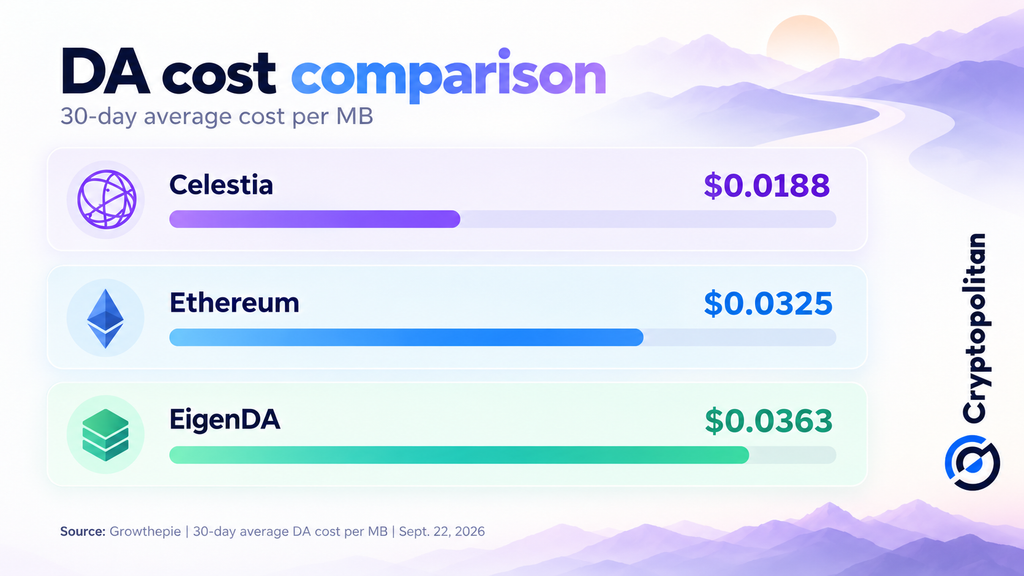
One of Celestia’s main advantages is its cost. According to Growthepie, Celestia’s 30-day average DA cost was $0.0188 per MB on September 22, compared to $0.0325 for Ethereum blobs or $0.0363 for EigenDA.
Celestia is also making efforts in terms of capacity. In January, it announced Fibre that is capable of processing up to 1 Tb/s across 500 nodes. This will be helpful for applications that require abundant, affordable blockspace.
Why cheap blockspace is the hard part
The problem is that making blockspace more abundant can cause blockspace fees to drop sharply.
In May 2025, after the Ethereum Pectra upgrade allowed the doubling of blob throughput, analysts at Galaxy Research found that blob object rollback fees dropped by almost 100% from the previous average of $16,250 per day. According to Galaxy, this figure does not include the separate type-3 transaction fees, but the overall lesson still stands: higher throughput usually means more transactions and lower profit per transaction.
This is the problem that Celestia is trying to solve.
It has been reported that the dedicated DA layers have become popular for rollups because of the cheaper alternatives they provide to Ethereum. Celestia is looking to keep the benefits of DA but charge more for higher-value guarantees and services to be provided over the cheaper, permissionless base DA.
Next comes an even more focused step than tokenomics overhaul: determining feasibility. Before a vote can be cast, the proposal has to specify who will get the money, how much TIA will be used, when payment can be made, and how to know if the proposal meets its goals.
This means the feasibility phase will be the first concrete trial of Celestia’s “blob economy” moving beyond being a piece of governance proposal into a sustainable business model.
Don’t just read crypto news. Understand it. Subscribe to our newsletter. It’s free.