




Bitcoin’s miner supply picture remains tighter than in past cycles, but not tight enough to call it a true supply shock. New data from Axel Adler Jr.’s latest Bitcoin Morning Brief suggests miners still retain a meaningful over-the-counter reserve even as exchange-directed selling pressure stays elevated.
Bitcoin Miners Flash Mixed Signal
Adler’s core argument rests on two separate but related indicators. One tracks the 30-day moving average of BTC inflows from miners to exchanges, which serves as a direct proxy for realized selling pressure entering the market. The other measures the aggregate BTC balance held on OTC addresses associated with miners, offering a view into how much inventory can still be sold outside public order books.
Taken together, the charts point to a market that is absorbing ongoing miner distribution, not one that has suddenly run out of hidden supply. As Adler put it, “For the market this is a mixed signal: the hidden OTC overhang is limited compared to past cycles, but tactical pressure in the market channel has not yet been removed.”
That distinction matters. A low OTC balance can be read as constructive because it implies miners have less sidelined inventory available for large off-exchange deals. But if the coins miners are currently producing are still being routed to exchanges at an elevated pace, immediate market pressure remains intact.
The exchange inflow data is central to that argument. According to Adler, miner exchange inflows rose noticeably after Halving #4 relative to the early post-halving period, and the trend accelerated further from autumn 2025 onward. By 2026, the 30DMA remained in what he described as an elevated regime, indicating that “a significant portion of freshly mined supply is still being directed into the market, and current miner pressure cannot be considered removed.”
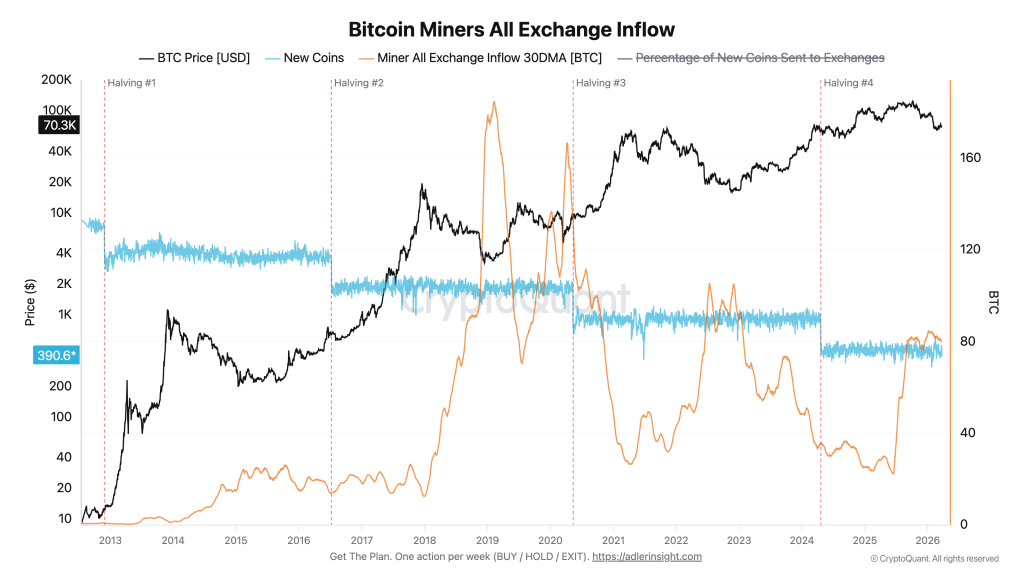
Recent weeks have shown some moderation from the latest highs, but Adler does not view that as decisive. “In recent weeks the chart shows a local pullback from recent peaks,” he wrote. “But against the backdrop of strong growth over recent months, this does not yet look like a confirmed downward reversal – rather a pause within a still-elevated exchange inflow regime. To speak of a real reduction in miner pressure, a more sustained decline of the 30DMA from the current elevated zone is needed, not a short oscillation within it.”
The OTC side of the picture is more nuanced. Miner-linked OTC balances currently sit around 152.6K BTC, well below the historical peak near 595K BTC in 2018 and only modestly above the series low of roughly 146.9K BTC recorded in July 2025. By long-term standards, that does leave the OTC reserve compressed.
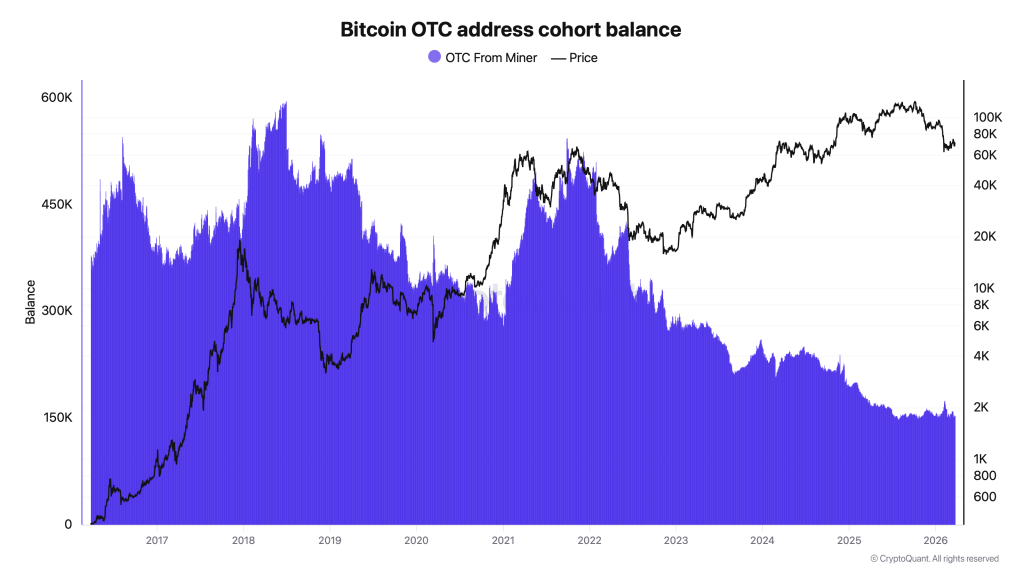
Still, Adler explicitly pushes back on the idea that the reserve is effectively gone. “The current level is close to the lower bound of the historical range, but claiming the buffer is ‘almost entirely exhausted’ would be an overstatement: more than 150K BTC is still a significant volume,” he wrote. “In recent months the OTC balance has been oscillating within a relatively narrow range, and in February there was even a noticeable upward spike. This looks more like a regime of low but persisting reserve than a final phase of complete buffer depletion.”
That framing is the key to the piece. The report does not argue that miner supply is abundant. It argues that the supply backdrop has become structurally tighter than in earlier cycles without yet crossing into outright scarcity. Miners have “substantially less OTC inventory than in past cycles,” Adler said, but the reserve “has not disappeared.” Instead, it “no longer looks large enough to create the same hidden supply overhang the market could see previously.”
At press time, BTC traded at $