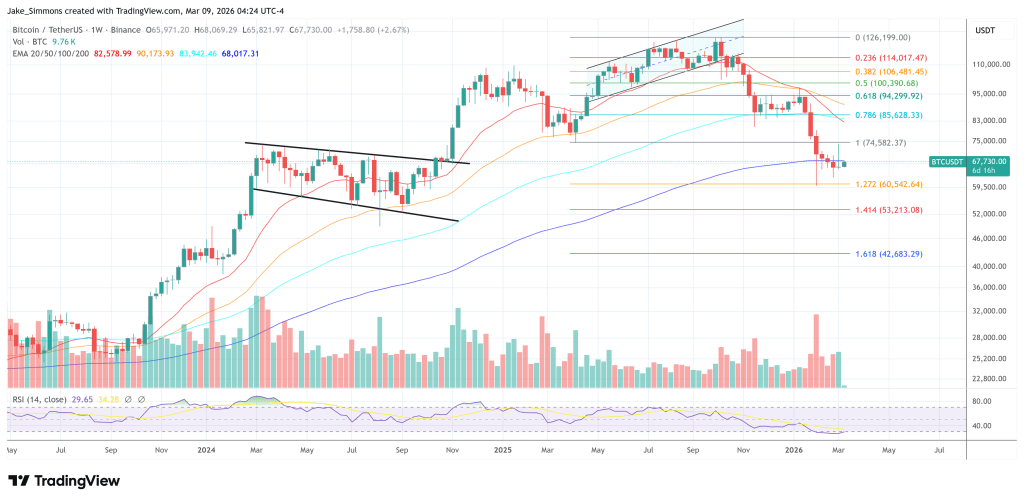




A growing share of Bitcoin supply has slipped underwater, with CryptoQuant contributor Darkfost arguing that the market is now sitting much closer to historical bear-phase conditions than to a confirmed bull trend. His latest charts show 43% of Bitcoin supply held in UTXOs is currently in loss, leaving just 57% in profit.
Darkfost is looking at the distribution of supply across Bitcoin’s unspent transaction outputs, a way of tracking how much coin supply is sitting above or below cost basis. In his reading, that metric has reached a zone that has historically marked the boundary between advancing bull markets and broader corrections.
“Roughly one out of two investors is currently at a loss. More precisely, this refers to the supply held within each UTXO on Bitcoin. At the moment, 43% of that supply is in loss,” he wrote on X. He added that “historically, as the histogram shows, we usually see around 75% of the supply in profit,” describing that level as a “rough boundary between a bull trend and a market correction.”

That framing is central to the thesis. When the share of supply in profit rises back above roughly 75%, Darkfost said, bull trends have typically “confirmed and accelerated.” When more supply starts falling into loss, the opposite tends to happen: corrections deepen, confidence weakens and the market begins to resemble prior bear-market structures. With Bitcoin now at 57% supply in profit, he said conditions look “closer to those seen during deep bear market phases.”
Still, he did not present the current setup as a one-way collapse. Darkfost said the market is showing signs of stabilization, which he linked to the current consolidation phase. But he also warned that the process may not be finished. “It is still possible that the market moves lower in order to shake out LTHs further and push the share of supply in loss toward around 45%, a level that has been reached during previous bear markets,” he wrote.
Macro Backdrop Weighs On Bitcoin
His second chart ties that on-chain deterioration to a macro backdrop that has become less supportive for risk assets. As tensions around the Strait of Hormuz intensified, Darkfost argued, oil’s rally has added another layer of pressure to Bitcoin.
“Since the beginning of the year, oil has gained more than 60%, a dramatic increase reflecting market concerns over the geopolitical situation,” he wrote. “This is not surprising, given that the Strait of Hormuz accounts for about 20% of global daily oil exports and nearly 35% of oil transported by sea. Any incident that blocks the strait or disrupts transit therefore has an immediate impact on oil prices.”
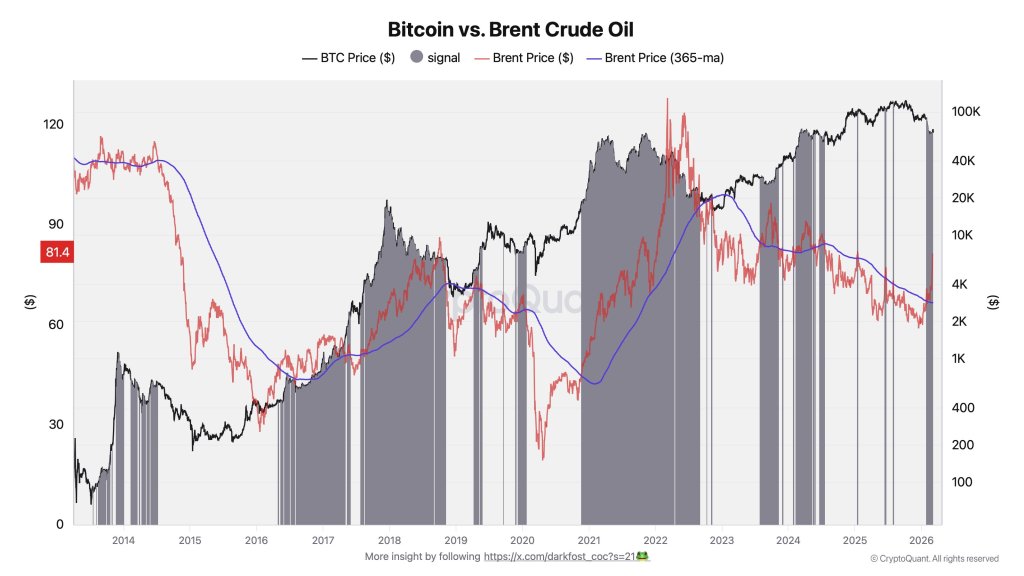
He extended that argument beyond energy markets. Higher oil prices, he said, feed directly into inflation expectations and broader financial-market stress, a combination that has historically not favored speculative assets. “For a volatile and risky asset like Bitcoin, this type of environment is unfavorable,” Darkfost wrote. “Historically, periods when oil prices regain strength often coincide with BTC end-of-cycle phases. These moments also signal geopolitical tensions, which are not conducive to risk-taking or exposure to more speculative assets.”
Taken together, the two charts sketch a market that is not yet definitively in a bear trend but is drifting toward a zone where that label becomes harder to dismiss. The immediate question is whether Bitcoin can rebuild the share of supply back into profit and reclaim the historical 75% threshold, or whether macro stress and further long-term-holder selling push the market deeper into loss territory first.
At press time, BTC traded at $67,730.