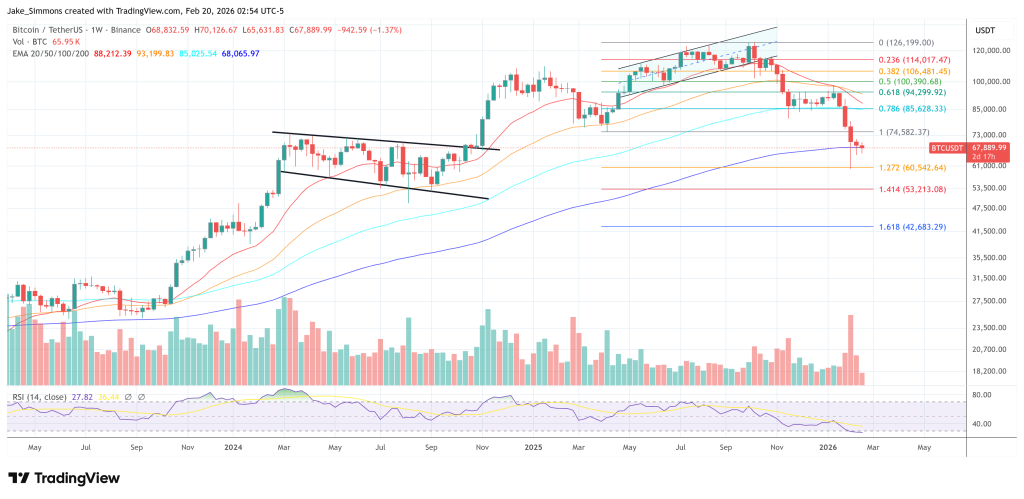




Bitcoin’s slide into the $60,000–$70,000 zone has lit up the usual “bottom” dashboards: extreme fear, washed-out positioning, and a cluster of indicators many traders treat as capitulation signals. But CryptoQuant contributor Mignolet says the market is missing the only thing that ultimately matters: a visible bid from dominant buyers.
“What I emphasized in the $80K–$90K range still remains the same,” he wrote on Feb. 18. “Many indicators that market participants follow are pointing to a bottom and extreme fear. However, we do not see dominant players (whales) actually using this situation.”
Mignolet’s core argument is simple: a bottom is not a sentiment reading, it’s an event and he doesn’t see the kind of forced absorption that typically marks a durable turn. “No matter how many indicators suggest a bottom, if there is no real buying force stepping in, we cannot know where the true bottom will be,” he said. “That is why I do not make price predictions lightly.”
He contrasted the current tape with the 2024 bull cycle, when fear could still dominate headlines even as large allocators quietly took the other side. In that period, he argues, the market had a measurable backstop: institutional demand showing up through US spot Bitcoin ETFs, specifically BlackRock’s IBIT and Fidelity’s FBTC, which “clearly absorbed the selling pressure.”
The “most important point,” in his framing, is that the same mechanics aren’t showing up now. Mignolet says the accumulation pattern FBTC sustained for roughly a year has “already broken down,” and IBIT, previously described as a buffer during heavy sell pressure, is “now trending downward, unlike last year.”
That shift is why he keeps the bottom call “on ice,” even if price ultimately holds the current region. In his view, Bitcoin remains in a phase where traders should “be cautious about further shocks,” and even a successful defense would likely require time before it can be treated as confirmed.
When Everyone Reads The Same Bitcoin Data
Beyond flow, Mignolet is also warning about a structural change in how market narratives form. He argues the proliferation of on-chain analytics has made the space more information-dense, but not necessarily more insightful and in some cases, more hazardous.
“The problem is that everyone looks at the same data and often reaches similar conclusions,” he wrote. “In many cases, even the people producing the data do not fully understand it. When information becomes too common, it pushes expectations in one direction.”
He describes today’s well-packaged on-chain dashboards as “clean and convincing, almost like an answer sheet,” which can harden conviction precisely when flexibility is required. The downstream risk, he suggests, is that widespread agreement around “obvious” bottoms can keep investors anchored through deeper drawdowns or longer grind periods.
In the near term, Mignolet’s base case is not a clean trend reversal but “sideways movement without a clear direction,” with enough volatility to create opportunities for short-term traders. For his own positioning, he described the period as “waiting,” stepping back to watch “liquidity flows, supply and demand conditions, and overall market sentiment,” then “reset” his framework.
The bigger picture, he says, is still bearish and potentially more drawn out than he expected last year. His closing warning is that this down cycle is “unlikely to end lightly,” with the plausible outcomes being a larger-than-expected drop, a longer-than-expected sideways phase, or both.
At press time, Bitcoin traded at $67,889.