



The Bitcoin hash ribbons indicator has recently flipped back to a buy signal on the weekly timeframe, according to a Jan. 8 video analysis from crypto analyst Kevin (@Kev Capital TA). The setup matters, he argued, because the model has historically been associated with higher prices after corrective periods, even if its record is no longer spotless.
In the video, Kev Capital walked viewers through the weekly Bitcoin chart with the hash ribbons overlay, describing it as one of the higher “hit rate” signals in crypto’s technical playbook. “There have been 19 buy signals on the weekly time frame throughout all of Bitcoin’s history and it has an 84% hit rate of playing out,” he said, adding that such consistency is rare for any single indicator.
Hash ribbons attempt to infer miner stress and recovery by comparing short- and longer-term moving averages of network hash rate. Kev Capital framed it less as a simple “buy/sell” tool and more as a proxy for network health, where miner behavior can precede shifts in market structure. “It’s not just a buy and sell indicator. It’s tracking mining hash rate,” he said. “And what that basically means is it’s tracking the overall power and network health on the Bitcoin blockchain.”
The mechanics, as he explained them, hinge on the 30-day moving average of hash rate (his chart showed this as a green line) versus the 60-day moving average (a gray line). When the 30-day crosses below the 60-day, the model labels it capitulation, which he described as aligning with bearish price action and a weaker network backdrop. When the 30-day crosses back above the 60-day, the indicator prints a buy signal (shown as blue dots on his chart), which he interprets as miners “rebounding” after weaker operators have been forced out.
“Anytime that 30-day crosses below the 60, it marks a capitulation phase, which shows that there’s been bearish price action in a weaker network,” Kev Capital said. “Now, when it crosses back above is when you get the blue dots, and that is a buy signal. That’s when the 30-day moving average of hash rate crosses back above the 60-day moving average of hash rate.”
Bitcoin Hash Ribbons Buy Signal Returns
The near-term catalyst for his update was a fresh signal sequence around the end of December. Kev Capital said the hash ribbons flashed capitulation in the second-to-last week of December, followed by a buy signal in the last week of December. He noted the indicator was again “flashing a capitulation signal” during the current week, not yet confirmed which could set up another buy signal if the moving averages continue to “mingle” and then resolve higher.
He also spent time qualifying the model’s reputation. While he cited an 84% historical hit rate for the weekly buy signals, he said that earlier in the current cycle the indicator printed two buy signals: in May and July that did not deliver the kind of follow-through that has defined prior successful instances.
“We did go up from the original buy signal, but it really wasn’t a lot,” he said, contrasting that with prior hash ribbons episodes that “typically produce a 30 to 100% move.” In his telling, those underwhelming outcomes were enough to break what he described as a prior “100% hit rate” framing.
https://t.co/vfZFXTAN77 #BTC Weekly Hash Ribbons buy signal and what it means. #Crypto #Altcoins
— Kevin (@Kev_Capital_TA) January 8, 2026
Still, Kev Capital argues the context is now different because the latest signal comes after a drawdown. He referenced a 36% decline in Bitcoin during the recent corrective period and suggested the early signs of miner recovery, reflected in the moving averages stabilizing and attempting to turn up, are the conditions where the indicator has historically performed best.
However, he cautioned that timing is variable, saying the setup can take “two to four to six weeks” to play out, or move sooner.
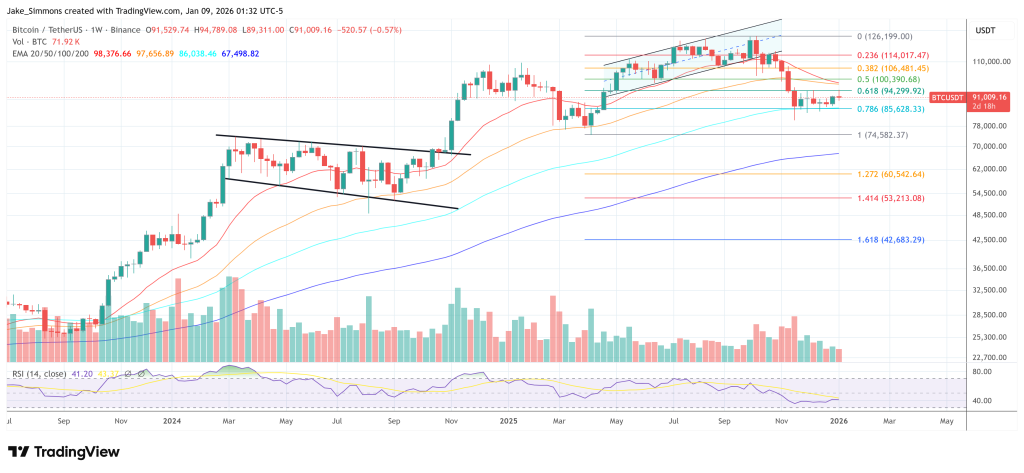
At press time, Bitcoin traded at $91,009.